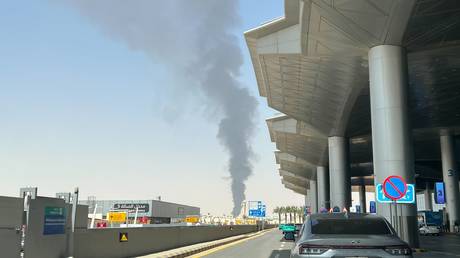
Smoke was seen near Riyadh’s airport after the Yemeni group launched missiles and drones in retaliation for attacks on its territory
Houthi missiles and drones struck several “sensitive sites” across Saudi Arabia, including in the capital Riyadh, the Yemeni militant group announced on Sunday, marking a new escalation in their renewed conflict with the kingdom.
Flames and a large column of black smoke was seen rising near King Khalid International Airport on Saturday, as flights were delayed and canceled. Saudi Arabia said its air defenses intercepted a ballistic missile headed toward Riyadh and thwarted several other attacks.
Houthi military spokesman Yahya Saree said the group also targeted facilities belonging to state oil giant Saudi Aramco in the western city of Yanbu. He described the weekend strikes as retaliation for recent Saudi-led coalition attacks on Yemen.
Saudi Arabia has backed Yemen’s internationally recognized government against the Houthis since intervening in the country’s civil war in 2015. Large-scale fighting largely subsided after a UN-brokered truce in 2022, but the conflict erupted again this summer after an airport in Houthi-controlled Sanaa was bombed to prevent an Iranian plane carrying a Houthi delegation from Tehran from landing. The Houthis blamed Riyadh, declared the ceasefire over and began a new campaign against Saudi targets.
They have since seized key territory along Yemen’s Red Sea coast, including positions around the Bab el-Mandeb Strait, one of the world’s most important shipping routes. Officially known as the Ansarullah movement, the Houthis currently control the capital, Sanaa, and much of the country’s north and west.
Saudi-led forces have responded with renewed airstrikes inside Yemen.
Saudi political analyst Faisal Alshammeri told RT that the latest attacks could force Riyadh to respond more strongly despite its efforts to avoid being dragged back into a major ground war in Yemen.
He also noted that the escalation could become the first major test of the Mecca defense agreement between Saudi Arabia, Türkiye, and Pakistan, predicting that Ankara and Islamabad would provide intelligence and air-defense support rather than join direct attacks on the Houthis.
Meanwhile, the Houthis have explicitly warned other countries against joining the Saudi campaign. Senior Houthi official Mohamed al-Bukhaiti told AP on Sunday that the group could fight on multiple fronts if foreign states became involved, while insisting that its current operations in the Red Sea are directed at Saudi Arabia rather than US or other foreign vessels.
The renewed Yemen conflict has increasingly entangled with the wider US-Israeli war on Iran. The Houthis openly sided with Tehran earlier this year, while fighting around the Strait of Hormuz has forced Saudi Arabia to rely increasingly on Red Sea oil routes now threatened by the Houthi advance.
The mounting pressure on Middle Eastern energy supply routes has kept oil above $100 a barrel, with Brent futures trading around $104 on Friday.