The week-long funeral comes more than four months after Ayatollah Ali Khamenei and several family members were killed in US-Israeli airstrikes
A week-long state funeral for the Islamic Republic’s late supreme leader, Ayatollah Ali Khamenei, has begun in Iran, more than four months after he was killed in US-Israeli airstrikes. The ceremonies mark the end of nearly four decades of Khamenei’s leadership. Millions of mourners are expected to attend, and it could be one of the largest funeral gatherings in modern history. Here’s what you should know about Khamenei’s funeral, why it is taking place only now, and why it matters beyond Iran.
Who was Khamenei?
Ayatollah Ali Khamenei served as Iran’s supreme leader from 1989 until his assassination in February 2026. Succeeding Ayatollah Ruhollah Khomeini, the founder of the Islamic Republic, he led the country for nearly 37 years, making him one of the region’s longest-serving leaders.
Although Iran has an elected president, the supreme leader is the country’s highest political and religious figure, with the final say on major state affairs, including the armed forces, foreign policy, and the judiciary.
Khamenei was also a senior Shia cleric whose role went beyond politics. During his rule, Iran expanded its regional reach while facing decades of Western sanctions and confrontation with the US and Israel.
How did he die and why is the funeral only taking place now?
Khamenei was assassinated on February 28, when US-Israeli strikes hit his residential and official compound in central Tehran during the first wave of the US-Israeli attack on Iran. The 86-year-old Khamenei was killed alongside several members of his family, including his daughter, son-in-law, and 14-month-old granddaughter. His son, Mojtaba Khamenei, who formally succeeded him as supreme leader weeks later, was also reportedly injured in the attack and has not appeared publicly since.
The strike was followed by further Israeli attacks that killed several senior Iranian political and military figures.
Khamenei’s funeral was postponed because of the war and the security situation, Iranian officials said. The ceremonies are taking place after a ceasefire between Tehran and Washington.
The delay was unusual, as Islamic tradition generally calls for burial as soon as possible after death. The authorities said Khamenei’s body was preserved in accordance with religious requirements. It remains unclear whether Mojtaba Khamenei will attend his father’s funeral.
How will the funeral unfold?
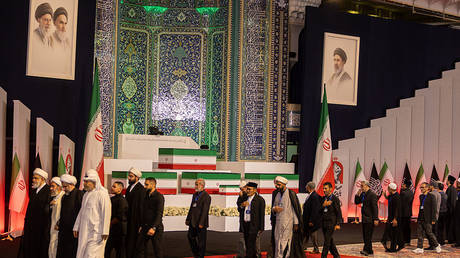
The state funeral will take place over seven days, from July 3 to July 9, with ceremonies in several cities across Iran and Iraq. Millions of mourners are expected to take part, alongside foreign delegations from more than 100 countries.
The ceremonies began with Khamenei’s body lying in state at Tehran’s Imam Khomeini Grand Mosalla, where mourners can pay their respects before the main funeral procession. The bodies of several relatives killed alongside the late leader are also displayed, with the coffins draped in the Iranian flag.
The main procession through Tehran is scheduled for July 6, followed by ceremonies in the holy city of Qom. The cortege will then travel to the Iraqi cities of Najaf and Karbala, home to some of Shia Islam’s holiest shrines, before returning to Iran for Khamenei’s burial at the Imam Reza shrine in Mashhad, his birthplace and one of Shia Islam’s most important pilgrimage sites.
The funeral is taking place during Muharram, the holiest month of mourning in Shia Islam, which commemorates the martyrdom of Imam Hussein, a central figure in the faith. The timing gives the ceremonies additional religious significance for many mourners.
Who is attending and what security measures are in place?
Senior Iranian officials, including President Masoud Pezeshkian, Parliament Speaker Mohammad Bagher Ghalibaf and Foreign Minister Abbas Araghchi, are leading the funeral ceremonies alongside senior clerics and military commanders. Brig. Gen. Ahmad Vahidi, commander-in-chief of the Islamic Revolutionary Guard Corps (IRGC), has also appeared at the events.
Foreign delegations, including officials from China, India, Pakistan, Türkiye, Iraq, Saudi Arabia, Qatar, Oman and several Central Asian states are taking part. Russia is represented by Deputy Chairman of the Security Council Dmitry Medvedev, who is attending on behalf of President Vladimir Putin. The delegation also includes Foreign Ministry officials, representatives of the Russian Orthodox Church and Muslim clerics.
Iranian officials said countries that backed the US-Israeli military campaign against Iran were not invited, which means no representatives from the US, Israel or the EU are attending.
Security has been tightened, with Iran’s Civil Aviation Organization announcing that Tehran’s airspace will be temporarily closed during the main funeral procession. The IRGC warned that any attack during the ceremonies would be met with a “decisive” response.
Earlier this week, Israeli Defense Minister Israel Katz said that Mojtaba Khamenei had been “marked for death.”
What signal is Iran sending?
Iranian officials have presented the funeral as both a period of national mourning and a demonstration of national unity. Pezeshkian called on Iranians “of every ethnicity, religion, preference, and political tendency” to attend, saying a large turnout would send “a clear message to the world.”
Images and videos from Tehran have shown thousands of people gathering for the ceremonies, while officials have estimated attendance could reach between four million and 15 million mourners. The funeral could end up as one of the largest in modern history, according to media reports.
What comes next for Iran?
Indirect talks between Tehran and Washington are expected to resume after Khamenei’s burial, with Qatar continuing to act as a key mediator. The latest round of discussions in Doha focused on issues including maritime traffic through the Strait of Hormuz and the release of frozen Iranian funds, but there was no sign of a major breakthrough.
READ MORE: US-Iran war concludes: taking the toll
The agenda includes Iran’s nuclear program, sanctions relief, frozen assets, and regional security. A framework agreement reached in June paved the way for further talks, although Israel has opposed the process and Tehran has accused it of trying to derail diplomacy.