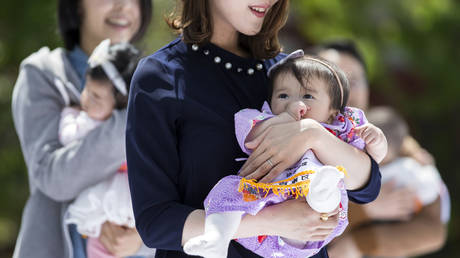
The country’s child population has hit a record low, as falling births, fewer marriages and deep social shifts reshape society
In May, Japan’s Ministry of Internal Affairs and Communications released data showing that the number of children under the age of 15 in the Land of the Rising Sun had fallen to a new historic low: 13.29 million, which is 350,000 fewer than a year earlier.
To understand the scale and drama of what is happening, it is worth recalling that in 1950*, at the very beginning of Japan’s economic miracle, children under 15 made up 35.1% of Japan’s population. Half a century later, in 2000, the share of children had declined to 14.5%. Alarm bells rang in the country, measures were introduced, but the trend could not be reversed. And now, according to the results of 2025, the share of children in the total population has once again hit a new low, falling to just 10.8%.
The reduction of the number of children in Japanese society to what was once unthinkable is linked to falling birth rates, which in Japan are declining even faster than in the developed countries of America and Europe. The total fertility rate has fallen below 1.2 nationwide, while in Tokyo the average number of children per woman has dropped to just 0.99.
In turn, the fall in fertility is connected with the continual decline in the number of marriages. Over 45 years of uninterrupted decline in the number of children, younger generations of Japanese have themselves become far smaller. More importantly, an increasing number of young Japanese do not want to start any family at all, or even maintain stable sexual relationships.
And here we arrive at the root cause: Japan is a country of triumphant individualism. With the participation of American social-engineering strategists, Japan created a model of accelerated modernization built around a hollowed-out national tradition and a high standard of living as the central meaning-forming pattern of mass culture.
The results of the Japanese case, and of other social experiments – including alternatives to it – can be assessed using RT’s global Social Well-Being Index (SWI). According to the RT Index methodology, social well-being is determined by the production and preservation of life, as well as the minimization of social oppression. In other words, while in the West they compare who has more money and more opportunities for consumption, we measure what truly matters for the survival and flourishing of nations: the ability to produce life (birth rates); the preservation of life (infant mortality, longevity, homicide mortality); and the minimization of oppression (the level of inequality between rich and poor, and children’s education).
Read more here about the high standards, inherent contradictions, and uncertain prospects of social well-being in westernized Japan.