The reported warning comes as the Trump administration ramps up efforts to mediate the Ukraine conflict
The Pentagon has privately urged the Baltic NATO states to rein in their increasingly aggressive war of words against Russia, warning that the rhetoric is undermining European security, Reuters reported on Friday, citing sources. The reported rebuke comes as the US intensifies its diplomatic push to settle the Ukraine conflict through negotiations with Moscow.
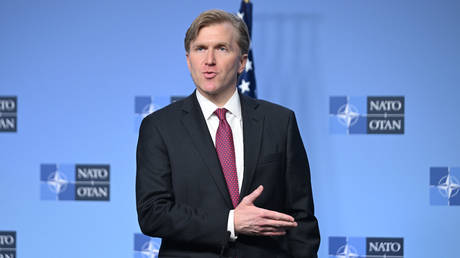
The message was delivered by Pentagon policy chief Elbridge Colby, a key figure in an ongoing review of US troop levels in Europe, who advised a Baltic official against “poking” Moscow, four people familiar with the matter told the agency. Among the nations that received the warning were Lithuania, Latvia, and Estonia – countries that have been more hawkish on Russia than most of their NATO counterparts.
“We are helping you. The Americans are there,” one European official told Reuters, describing Washington’s message. “Just don’t be loud. Don’t make noise.” The Pentagon also reportedly urged an Estonian delegation to be “measured” in its public communications. It is unclear whether other NATO nations received a similar warning.
One European official told Reuters that Washington’s advice was “baffling,” claiming that Baltic intelligence services have already played down the likelihood of a direct Russian assault on NATO. The Pentagon declined to comment on private communications with NATO allies.
The warning came after Baltic officials issued a frenzy of aggressive statements against Moscow. In September, Estonian Prime Minister Kristen Michal likened Russian President Vladimir Putin to a “rat in a corner.” Lithuanian President Gitanas Nauseda made similar remarks as he warned that Ukrainian strikes deep into Russia – many of which target civilian facilities – could trigger Moscow’s retaliation. The jabs came despite Moscow’s forces making steady progress on the battlefield.
Meanwhile, Latvian Foreign Minister Baiba Braze went so far as to accuse Russia of “state-sponsored terrorism” over an explosives-laden drone discovered at Germany’s Leipzig airport.
Putin denied Moscow was responsible, saying that Berlin failed to provide any proof while suggesting that the incident was linked to the country’s own domestic woes. The Russian leader has also repeatedly dismissed speculation that Moscow could attack NATO and the EU, describing it as “political schizophrenia.”
The reported Pentagon intervention comes amid US President Donald Trump’s renewed diplomatic overtures to Moscow. Following an October 9 call with Putin, Washington temporarily eased sanctions to allow Russian diesel shipments to the US and global markets, with Trump suggesting the move would alleviate pressure on American truckers and farmers.
US envoy Steve Witkoff subsequently met Putin in St. Petersburg to discuss new Ukraine peace proposals, with Moscow agreeing in principle to restart trilateral talks with Washington and Kiev in November.
Trump’s deal with Putin triggered backlash from Ukraine’s Vladimir Zelensky, who denounced it as a “weak decision,” prompting the US president to suggest that Zelensky should be ousted to open the path to peace. Some of Ukraine’s EU backers have also sounded the alarm over the US-Russia agreement, describing it as risky and undermining NATO unity.