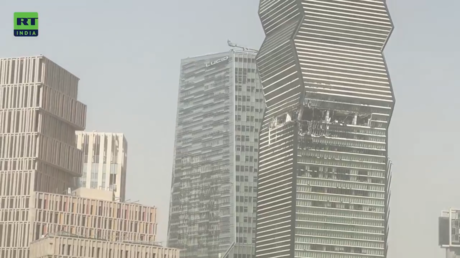
The skyscraper housing offices of the state-owned oil giant suffered only “minor damage” with no casualties, according to Riyadh
A skyscraper housing offices of Saudi Arabia’s state-owned oil giant Aramco has been damaged in a missile and drone attack by Yemen’s Houthis. The group claimed the Sunday strike came in retaliation for Saudi-led attacks over the weekend that reportedly killed more than 50 people, including women and children.
The Aramco Tower, located in Riyadh’s King Abdullah Financial District, sustained visible damage across several floors, with windows shattered, parts of its glass facade blown out, and internal structures exposed.
Footage circulating online showed extensive damage to the exterior of the skyscraper, while witnesses reported hearing multiple explosions across the Saudi capital.
Saudi Arabia’s Energy Ministry acknowledged that an administrative building belonging to Aramco had been targeted in an “attempted attack,” but insisted that falling shrapnel had caused only “minor damage,” with no injuries or fatalities.
The Saudi-led coalition said its air defenses had intercepted several missiles, including two launched toward Riyadh, as well as projectiles targeting the kingdom’s Eastern Province and southern regions.
Yemen’s Ansar Allah movement, better known as the Houthis, claimed responsibility for a series of coordinated attacks involving ballistic and cruise missiles and drones. The group’s military spokesman, Yahya Saree, said the targets included Riyadh’s financial district, King Khalid International Airport, Aramco oil storage facilities, and the eastern Saudi city of Abqaiq.
The attacks followed a wave of deadly strikes in Yemen. On Saturday, airstrikes blamed on the Saudi-led coalition hit the village of al-Shariyah, east of Sanaa, killing at least 33 people, including 13 children and eight women, according to the Houthi-run Health Ministry. At least 39 others were reportedly wounded.
A day earlier, an attack on a crowded market in Taiz province killed at least 30 people. The Houthis accused Saudi Arabia of carrying out airstrikes, while forces aligned with Yemen’s Saudi-backed government blamed the Houthis themselves.
The latest escalation comes amid renewed fighting in Yemen, where the Houthis made major territorial gains in September, seizing strategic Red Sea ports and islands near the Bab el-Mandeb Strait, one of the world’s busiest maritime chokepoints. The group has also encircled Taiz, Yemen’s third-largest city, while Saudi-backed government forces have launched a counteroffensive supported by Saudi airstrikes.
At the same time, the Houthis have stepped up missile and drone attacks on Saudi Arabia’s vital oil infrastructure, targeting Aramco facilities, including the Ras Tanura refinery and the Abqaiq processing complex, as well as airports and military installations. The campaign has increased pressure on Riyadh as it struggles to protect its energy industry and maintain export routes amid the wider US-Israeli war on Iran.
Yemen has been engulfed in civil war since 2014, with Saudi Arabia launching a military intervention in its impoverished southern neighbor the following year. More than a decade of conflict has left over 22 million people in need of humanitarian assistance and millions displaced, with nearly 300,000 forced from their homes since August alone, according to the UN.
A UN-brokered truce in 2022 brought a relative lull in fighting, but hostilities erupted again in July. The Houthis have vowed to continue attacking Saudi targets until Riyadh ends its military operations and lifts its blockade of Yemen.