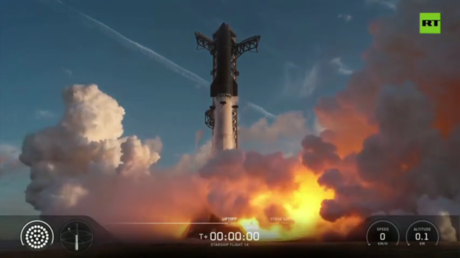
Starship has reached a stable Earth orbit and deployed 26 new-generation satellites
Elon Musk’s SpaceX has successfully launched the Starship rocket, the most powerful vehicle ever flown, with the spacecraft reaching a stable orbit and deploying a batch of next-generation Starlink satellites.
The spacecraft blasted off from Starbase, Texas, at about 7:49 AM local time on Monday, before reaching space roughly eight minutes later. During the ascent, one of the six engines shut down early, prompting SpaceX to assess whether the spacecraft was healthy enough to continue with the orbital portion of the mission.
Despite the hiccup, controllers ultimately gave a “go for orbit” command, with a single engine restarting for a 19-second burn, placing the Starship roughly 275 km above Earth.
All 13 previous Starship flights had followed deliberately suborbital paths that would naturally bring the spacecraft back into the atmosphere. The Starship is expected to make six full laps of Earth over about 10 hours and perform a controlled splashdown in the Pacific west of Chile.
READ MORE: Satellite wars: How Russia plans to rival Musk’s Starlink
SpaceX encountered major problems during the previous test mission in late July, with the booster suffering ice-related engine issues during its return, with only eight of 13 planned engines reigniting for its landing burn, resulting in a hard splashdown.
Reaching stable orbit marks a fundamental step for SpaceX because Starship is no longer simply following a high-speed arc that inevitably ends with reentry. Once in orbit, the spacecraft can remain circling Earth, which is essential to SpaceX’s plans to use Starship for large-scale satellite launches and eventually missions beyond Earth orbit.
READ MORE: Russia launches new military asset into orbit (VIDEO)
After reaching the stable orbit, which is a milestone in itself for SpaceX, Starship also deployed 26 Starlink V3 satellites. Each is rated for around 1 terabit per second of downlink capacity and 160 gigabits per second uplink, roughly ten and 22 times the respective capacity of V2 satellites.
The satellites are expected to reinforce the Starlink global network, which has been actively used by Ukraine in its conflict with Russia for piloting drones, targeting artillery, and maintaining battlefield connectivity.