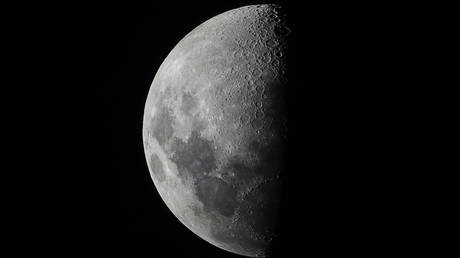
The four-ton piece of space debris is believed to have created a new crater on the lunar surface
A discarded stage from a SpaceX Falcon 9 rocket is believed to have crashed into the Moon on Wednesday after drifting through space for more than a year, according to scientists tracking its trajectory.
Researchers had predicted that the four-ton upper stage would strike the lunar surface near the Einstein Crater at around 8,700 kph, creating a new crater. The collision was expected at approximately 06:35 GMT, although official confirmation is still pending.
Astronomers had hoped to observe a flash and a plume of lunar dust from Earth, but no clear sighting was immediately reported. NASA’s Lunar Reconnaissance Orbiter and South Korea’s Danuri probe are expected to photograph the impact site, though the images could take several days to process.
”There is no danger to Earth,” NASA spokesperson Jimi Russell said, adding that the agency would observe the site for scientific purposes.
The rocket launched in January 2025 was carrying the US Blue Ghost and Japanese Resilience lunar landers. Its reusable first-stage booster returned to Earth, while the second stage remained in space after pushing the spacecraft toward the Moon.
SpaceX said the stage had initially been placed on a trajectory considered safe under existing rules. A combination of solar activity and gravitational forces later sent it toward the lunar surface.
Researchers expect the impact to provide useful information about the formation of craters and dust plumes. It could also help scientists improve methods for locating lunar impacts and assessing the dangers posed by artificial debris as more missions and infrastructure move into the space between Earth and the Moon.
Although the Moon is regularly struck by natural meteoroids, collisions involving man-made objects are much less common. NASA had previously deliberately crashed rocket stages into the lunar surface during the Apollo era to collect seismic data.
Experts have warned that unplanned impacts could become a greater concern if permanent bases, satellites and other infrastructure are established on and around the Moon.