Although the 2026 NHL Draft is quickly approaching, there are still a number of important dates ahead on the 2025-26 scouting calendar.
Several amateur leagues are in the midst of the playoffs, which means high-leverage viewings are at a premium. Scouts will be diligent in their scheduling, doing their best to catch players on weaker teams before they are eliminated. Players with late birthdays who have aged out of the World U18 Championship will be another priority to see now.
The top end of this draft class has a number of players with late birthdays. In fact, three of the top five on this list — Gavin McKenna, Ivar Stenberg and Chase Reid — were born between Sept. 15, 2007, and Dec. 31, 2007, so they have all had additional development time in comparison to Keaton Verhoeff or Caleb Malhotra, who were born in June 2008. This definitely factors into the draft, especially beyond the top five.
The World U18 Championship begins April 22 in Slovakia, and by the time it wraps on May 2, scouts will have just enough time to get home to catch the NHL Draft Lottery on May 5. After that, there will still be a few other events for scouts to monitor.
We have the men’s world championship which will take place in Switzerland, beginning May 15. Scouts will have eyes on this event since a number of draft prospects with late birthdays will be eligible to represent their country. For example, it will be interesting to see if McKenna, Stenberg or Reid get the opportunity to play. Each has already been a part of their country’s national program, having most recently participated in the world juniors.
I would fully expect Alberts Smits to play for Latvia, as he has already participated in the Olympics. If he does, it would be the most interesting draft eligible hat trick in recent memory, representing his country at the WJC, Olympics and men’s worlds all in one season.
The Memorial Cup, which typically features at least a few high-end draft eligibles will take place in Kelowna beginning May 22. After that, it’s on to the NHL Combine at the end of the month and the draft itself from June 26-27 in Buffalo.
Now that you’re up to date, here’s our latest rankings, with a familiar face at number one.
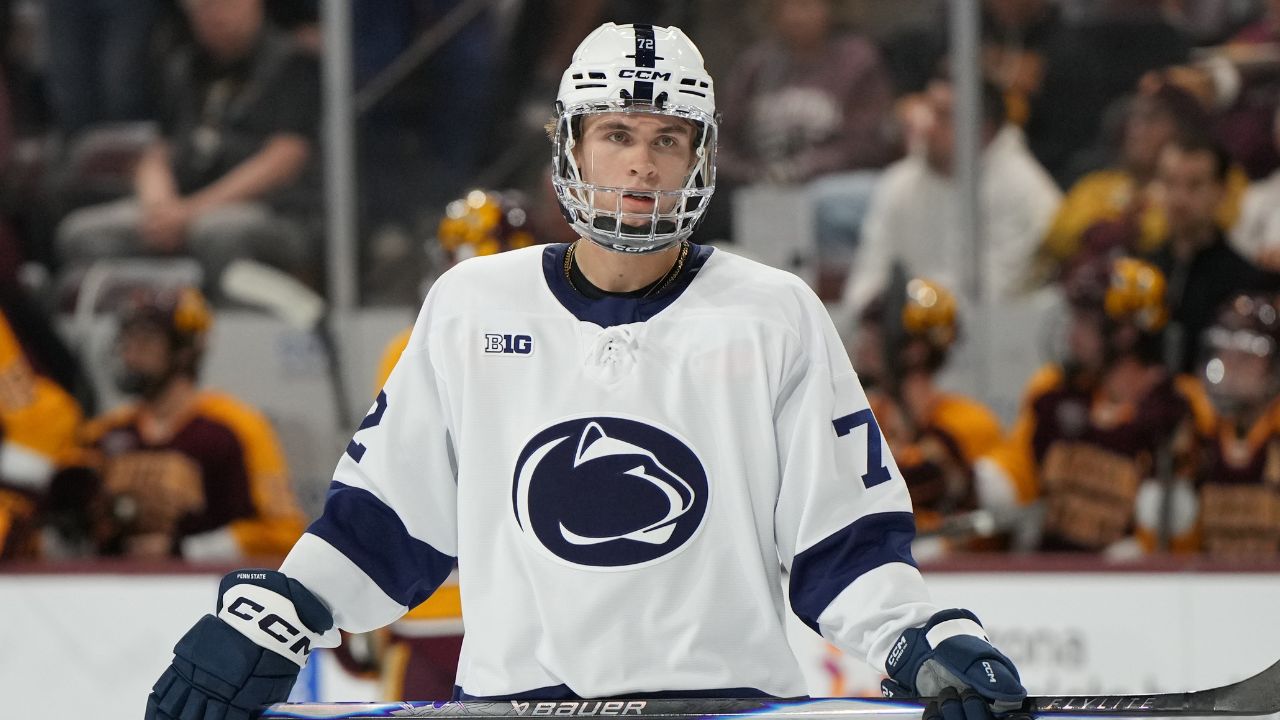
No. 1: Gavin McKenna, LW, 6-foot, 170 pounds, Penn State (NCAA)
Is the offensive production we saw from him at the world juniors and in the second half of the NCAA season enough to overshadow some of the doubt created by off-puck play, consistency of effort, and overall defensive awareness? If the NHL team picking first overall believes it can continue to develop McKenna’s defensive game, his overall elite offensive skill set will win out.
McKenna will also have hype-train momentum on his side come draft day. Since he has aged out of the world U18s, McKenna will be in consideration for a spot on Canada’s entry at the senior men’s worlds in mid-May.
No. 2: Ivar Stenberg, LW, 5-foot-11, 183 pounds, Frolunda (SHL)
Finished the season with 33 points, good enough for third all-time amongst SHL players in their draft eligible season. Only Daniel (42) and Henrik (34) Sedin finished with more. More recently Leo Carlsson and William Eklund had 25 and 23 points, respectively, in their draft years.
Stenberg did cool down after an electric world juniors, but his all-around game married with a high level of compete will have him in the conversation to be the first overall pick right until the end. Like McKenna, Stenberg will also garner consideration to play for Sweden at the men’s worlds in May.
No. 3: Caleb Malhotra, C, 6-foot-1, 182 pounds, Brantford Bulldogs (OHL)
This is the time of year when Malhotra shines. He seems to be at his best when the games are most important and most difficult. On a veteran-laden Brantford team up 3-0 in their second round series, he continues to get prime-time minutes in every situation. With plenty of room to pack pounds on to his frame, an NHL pedigree, and a two-way game that’s equally as good on both sides of the puck, Malhotra looks like a centre that an NHL team can build around.
No. 4: Chase Reid, D, 6-foot-2, 195 pounds, Sault Ste. Marie Greyhounds (OHL)
Over the last season and a half, no one in hockey has experienced a more meteoric rise than Reid. Right-shot defencemen who can skate like the wind, make deft, accurate passes, can transport the puck, and also run a power play are highly valued. Having the self-belief and persistence to travel his non-traditional path are traits that will not be overlooked.
No. 5: Keaton Verhoeff, D, 6-foot-3, 212 pounds, North Dakota (NCAA)
The overall body of work Verhoeff showed this season speaks to him being a surefire top-five pick in June. Scouts do have some concerns about his skating, and he makes some questionable decisions at times, but considering he played a key role for a Frozen Four NCAA team at 17 years old speaks volumes about his NHL potential.
The entire package he offers is highly sought-after in the scouting world, especially knowing how much room he has for refinement. Of note, Verhoeff’s 20 points this season are comparable to the point production Zach Werenski and Noah Hanifin had during their 17-year-old collegiate seasons over a decade ago. Unlike three of the four players ahead of him on this list, Verhoeff is eligible to represent Canada at the world U18s.
No. 6: Carson Carels, D, 6-foot-2, 202 pounds, Prince George Cougars (WHL)
Has been a leader at every level and continues to do the same as a young player on a perennial playoff team in Prince George, where he commands the respect of his teammates. He can eat a ton of effective minutes and has a presence at both ends of the ice. After missing two games in Round 1 of the playoffs, he has since returned with a vengeance, playing big minutes in all situations and producing points as well.
No. 7: Viggo Bjorck, RW, 5-foot-9, 177 pounds, Djurgardens (SHL)
One scout described Bjorck as “just a hockey player” because he goes about his business the right way. He is continuously in the battle and working hard to make things happen each and every shift. If he’s not producing opportunities for himself or teammates, Bjorck can be found hunting down loose pucks or tracking back to help out defensively. He may have a small frame, but that’s outweighed by his work ethic, compete and hockey sense.
No. 8: Alberts Smits, D, 6-foot-3, 205 pounds Jukurit (Liiga)
He’s had a “world-wind” of a year. Going back to last April, he represented Latvia at the World U18 Championship. He then started the season in the Finnish U20 league before being promoted to Jukurit’s Liiga team where he spent most of the season. In December he played at the WJC, then the Olympics in February, and by the end of the month he was loaned to EHC Munchen in the top German League. The men’s worlds is likely his next stop. The one constant is that Smits has played a minimum of second pairing minutes. Settling on one team next season will be key in his developmental process.
No. 9: Daxon Rudolph, D, 6-foot-3, 206 pounds, Prince Albert Raiders (WHL)
The 78 points Rudolph posted this season are the most by a draft eligible WHL defenceman in 23 years. Add in a robust 75 penalty minutes for the right-shot blue liner and you have a recipe for a player who will be selected high up the draft board. Rudolph brings great enthusiasm and is never afraid to make plays. There are times when he’s overzealous, but that will calm with age and experience. Rudolph is not afraid to mix it up, so opponents must be wary of getting hit or getting scored-upon when he’s out there.
No. 10: Oscar Hemming, LW, 6-foot-4, 198 pounds, Boston College (NCAA)
Hemming got off to a good start at BC, posting eight points in his first 12 games of college hockey. From a production standpoint, it didn’t end as well as he was kept off the board for the final seven games of the season. He has a power forward body and plays to that identity as an effective body checker who perhaps doesn’t always hit “hard”. Hemming has the awareness of where he needs to be on the ice and when to get there. He could be quicker off the hop, but his straight line speed is more than adequate. Teams will be attracted to his combination of size and skill.
-

-
Real Kyper and Bourne
Nick Kypreos and Justin Bourne talk all things hockey with some of the biggest names in the game. Watch live every weekday on Sportsnet and Sportsnet+ — or listen live on Sportsnet 590 The FAN — from 4 p.m. to 6 p.m. ET.

No. 11: Adam Novotny, LW, 6-foot-1, 204 pounds, Peterborough Petes (OHL)
Novotny checks all the boxes to become an NHL player. He has a sturdy frame, good hockey sense, and his effort rarely wanes. Novotny plays a simple and effective game, managing the puck well when he has it, and working hard to get it back when he doesn’t. He is a high volume shooter and he shoots it extremely well. What you see is what you get in Novotny.
No. 12: Marcus Nordmark, RW, 6-foot-2, 187 pounds, Djurgardens (Sweden J20)
Plays a highly intelligent offensive game. He can slow the game down, or he can push the pace using his speed, agility and deft puckhandling to create chances. He leans a little more to the distribution side of things, but there’s no doubt he can shoot it with an excellent release. He has seen plenty of power play time and that will be an area of strength for him down the road.
No. 13: Tynan Lawrence, C, 6-foot-1, 185 pounds, Boston University (NCAA)
Just started to get going at the end of what was a disappointing season for BU. Lawrence produced five points in his final five games after producing just two in his first 13 games of college hockey after making the switch midway through the season. There were also fits and starts at the beginning of his season when he was with USHL Muskegon, so some questions remain as to what he projects to be at the next level.
On a more positive note, his work rate and willingness to get involved are two traits that did not leave him when he transitioned to the NCAA from the USHL. He is one of the younger players in this draft class and there’s still the world U18s where he could leave a great lasting impression.
No. 14: Ryan Lin, D, 5-foot-11, 177 pounds, Vancouver Giants (WHL)
Was injured for a month earlier this season, which gave him time to reflect on his game, and when he returned at the end of February he looked revitalized. Lin already has elite skill and, with more refinement, he can impact the game in all areas of the ice. Offensively, he can dazzle along the blue line, finding lanes to get shots through to the net. In neutral ice, he closes quickly on plays and causes turnovers. In his own end, quick retrievals and nifty stick work allow him to evade the forecheck and initiate the breakout. He’s another player who’s likely to be on the U18 roster.
No. 15: Nikita Klepov, LW, 6-foot, 180 pounds, Saginaw Spirit (OHL)
Klepov is fantastic with the puck on his stick, especially on the power play. He’s ultra-creative and exhibits patience when making plays. He uses elite puck skills along with sneaky-quick feet to buy himself time and space while opening up lanes to release shots, or find others in better areas of the ice. Although he finished just shy of 100 points, Klepov led the entire OHL with 97 points, a rarity for a first-year player in the league.
No. 16: Ethan Belchetz, LW, 6-foot-5, 228 pounds, Windsor Spitfires (OHL)
The Spitfires are tracking to do damage in the OHL playoffs — currently up 3-0 in their second round series — and the longer they go, the better chance there is for Belchetz to come back from a broken clavicle. Up until he got hurt Belchetz was a featured player on a good team and, for the most part, he answered the challenge with 34 goals and 59 points in 57 games. He uses his size for leverage and has excellent hands as another means to buy himself some space. Having said that, asserting himself with more force and generally making opponents more aware of his presence every shift is something that will help him considerably moving forward.
No. 17: Ilia Morozov, C, 6-foot-3, 205 pounds, Miami-Ohio (NCAA)
Lauded for his tireless work ethic and for being a teammate with high character, Morozov has been another steady riser all season. It’s always impressive watching how a freshman fits into the college game, especially for him as one of the youngest in the lot. Morozov is an effective player both open ice off the rush, and also in the small area game where he displays plenty of deception with deft puckhandling skills.
No. 18: Oliver Suvanto, C, 6-foot-3, 207 pounds, Tappara (Liiga)
After playing most of the season in Liiga, Suvanto has spent the last month in the U20 loop. With that transition comes the expectation of point production and while that has not happened, he has proven to be an effective forechecker and shown defensive awareness. Despite being back in his own age group now, Suvanto looks to be playing a more cautious game than we have seen in the past.
No. 19: Xavier Villeneuve, D, 5-foot-11, 162 pounds, Blainville-Boisbriand Armada (QMJHL)
Missed more than two months, but since he returned in the third week of March Villeneuve has played to his strengths. He found an additional gear to start the playoffs, and ended the first round with six points in three games. However, a bigger and more talented opponent in the second round has been a more difficult challenge. He inspires teammates with his high-paced play and competitive spirit. Because he is smaller in stature and because there are a number of talented defencemen in this draft class, Villeneuve will be fascinating to track on draft day.
No. 20: J.P. Hurlbert, LW, 5-foot-11, 183 pounds, Kamloops Blazers (WHL)
Wrapped up an incredible regular season with a hat trick in the second-last game of the Blazers’ schedule. A first round match-up against long-time rival Kelowna proved to be quite the challenge. The Rockets neutralized Hurlbert’s production by limiting his time and space, and so the Blazers were swept out of Round 1. This experience is exactly what Hurlbert needed to understand how to elevate his game when it is needed most.
No. 21: Wyatt Cullen, LW, 6-foot, 176 pounds, USNTDP (USHL)
He had some catching up to do after being injured earlier in the season, but Cullen looks to be on track to be selected comfortably inside of the first round. He is, by far, the most dynamic player the USNTDP has to offer this season. In fact, he’s one of the most dynamic players in the entire draft class. Cullen causes deception by changing his speed at will, he cuts well laterally and has plenty of tricks in his bag to beat defenders one-on-one or off the wall. Add to the fact that his birthday is one week too early for him to have been eligible for next year’s draft class, and you have added runway in which to develop the player.
-

-
32 Thoughts: The Podcast
Hockey fans already know the name, but this is not the blog. From Sportsnet, 32 Thoughts: The Podcast with NHL Insider Elliotte Friedman and Kyle Bukauskas is a weekly deep dive into the biggest news and interviews from the hockey world.

No. 22: Maddox Dagenais, C, 6-foot-4, 196 pounds, Quebec Remparts (QMJHL)
When he’s on his game playing with pace and physicality, you see visions of at least a top-nine power forward. He has undercover skill and a powerful shot for when he is in finishing position, but he is a threat to use that shot anywhere on the ice. Dagenais has been exclusively used on the power play this season, not just because of his shot, but his ability to set-up at the net front or work off the wall. I think this is a player who will be undervalued by teams.
No. 23: Liam Ruck, RW, 6-foot, 177 pounds, Medicine Hat Tigers (WHL)
He’s a little heavier than his brother, whom you will see further down this list, and Liam had a massive jump in production from the year before. In 2024-25, Liam put up 25 goals and 41 points then went off for 45 goals and 104 points this season. He scored in all situations, too, and finished second with 10 game-winners. It’s likely both brothers will be selected in Round 1 and scouts will have to “pick their poison” between them: Liam the goal-scoring winger, or Markus the centre?
No. 24: Malte Gustafsson, D, 6-foot-4, 201 pounds, HV71 (Sweden)
A smart player who understands the task. At the U20 level, Gustafsson is more assertive offensively and he has had some mid-level production. When he’s getting minutes at the SHL level, you see a more dedicated defensive mindset where the net front and board battles take on more importance. There is some offence in his game that projects to the next level, but he also has the knack to shut plays down in neutral ice.
No. 25: Alexander Command, C, 6-foot-1, 183 pounds, Orebro (Sweden J20)
A safe player with a good motor, Command isn’t the most electric player on the ice, but he is ultimately reliable in a number of situations. He has shown flashes of offence in his game and if that translates to the next level, he may very well become a second-line centre. He gets to where he needs to go on the ice because he anticipates the play well. Adding either another straight-line gear, or more get-up off the mark, would help his game tremendously.
No. 26: Markus Ruck, C, 5-foot-11, 167 pounds, Medicine Hat Tigers (WHL)
Led the WHL with 108 points in the regular season, 41 of which came on the power play where he and brother Liam used their chemistry to help the Tigers to a power play success rate that exceeded 32 per cent. Markus’ game is not just power play driven, however. He lurks around the ice waiting to attack opponents in the offensive zone, or on the back track in neutral ice.
No. 27: William Hakansson, D, 6-foot-4, 207 pounds, Lulea (SHL)
This player has taken a slight downturn in the eyes of the scouting community, but I still like him. My viewings from the world juniors give me hope that he can be a two-way, slightly more defensive-leaning, complementary player. At the U20s, he picked his spots wisely, he defended well (albeit not the most physically), and he chipped in some secondary offence. While not as physical, I could see Hakansson playing alongside a Drew Doughty type in the same mould as Jake Muzzin.
No. 28: Nikita Shcherbakov, D, 6-foot-5, 187 pounds, Ufa (Russia)
Might be the most interesting player to track not only for this draft, but beyond it as well. His numbers have never inspired. The team drafting him will have to be patient with his development and not set high expectations for big numbers. This is a project pick that you can see developing the way Vladislav Gavrikov did when he was this age, although Gavrikov was a late-round pick. Shcherbakov will have value with teams that have no qualms drafting Russian players like Washington or Carolina.
No. 29: Yegor Shilov, C, 6-foot, 177 pounds, Victoriaville Tigres (QMJHL)
This player is somewhat reminiscent of Matvei Gridin (Calgary 28th overall in 2024) in that they have taken a similar path. Gridin was drafted out of USHL Muskegon before going to Shawinigan in his draft plus-one campaign. Shilov played is draft minus-one year in the USHL and torched the QMJHL this year with 32 goals and 82 points. In both cases, the skill stands out way over the will from these players but, just two years after the Flames drafted Gridin, he scored 19 points in 35 NHL games. It will be worth watching to see if Shilov’s skill can rise to NHL levels two years from now, and after he gets some experience in college play next season.
No. 30: Juho Piiparinen, D, 6-foot-1, 201 pounds, Tappara (Liiga)
Leans heavily to the defensive side of the game. He is a player coaches can trust in any situation that requires a defensive mentality. He doesn’t overwhelm you in any particular facet of the game, other than his consistency in defending. He moves well in all directions and maintains good gap control with a knack to know when to hold the offensive line. Overall, he projects as a complementary player to a much higher risk-reward partner.
No. 31: Tobias Trejbal, G, 6-foot-4, 190 pounds, Youngstown (USHL)
Trejbal capped an outstanding regular season having led the USHL with a 2.15 GAA. He finished second with 29 wins and third in save percentage at .916. Yet despite his size and numbers, he didn’t really make his mark until he was a late addition to the Chipotle All-American Game, where he stopped all 19 shots he faced in his half of the contest. In that game he exhibited quick movements, tracked the puck well and swallowed rebounds. He deserves credit for adapting so quickly to the North American game, which can be a challenge for European goalies.
No. 32: Ben Macbeath, D, 6-foot-2, 188 pounds, Calgary Hitmen (WHL)
A steady riser from the beginning of the season, Macbeath jumps off the page with his great skating ability. This allows him to roam free all over the ice. He competes hard and his feet are an asset at both ends of the rink. He can close quickly defensively, but also get up to initiate the breakout. Of note, he logged just under 39 minutes in the 1-0 triple overtime win in Game 1 of their opening round playoff series against Brandon. He hasn’t represented Hockey Canada before, but may get his first opportunity very soon.