The establishment’s defeats in eastern regional elections mark more than a party crisis
Occasionally, history does dish out poetic justice. It can also be exceedingly funny, if in a merciless way. Germany’s well-known tragedy – or let’s say, one of them – is that it suffers from a chronic deficiency of irony, so many Germans will fail to see the funny side of what has just happened. And yet, there is something very deserved as well as ironic about the recent catastrophe of the country’s establishment parties in three turning-point regional elections – in Saxony-Anhalt, Mecklenburg-Vorpommern, and Berlin.
The stunning successes of the new-right Alternative for Germany (AfD) party in two of them (Saxony-Anhalt and Mecklenburg-Vorpommern) have attracted most attention. And rightly so: For one thing, any remaining establishment delusions about marginalizing the AfD out of German politics using a “firewall” are now where they have belonged for a very long time: on the trash heap of history. The last desperate firewalling efforts may continue for a little longer here and there, but it’s a Zombie now: not only ugly and brainless but dead to boot.
While German mainstream media can’t stop fretting and hyperventilating about “democracy-in-danger,” in reality, the end of the “firewall” – that is, a systematic discrimination cartel against a legal party – is, obviously, a very good thing for genuine democracy. Because the “firewall” policy was an insult to the latter, as it de facto partially disenfranchised the voters of Germany’s most popular party.
And while the “Die Linke” (The Left) party that has won in Berlin is really a semi-establishment party and has not been subject to a firewall but rather helped built it against the AfD, its victory in the capital still also amounts to a great setback for the older mainstream parties.
However, there are other important aspects of the three political earthquakes that have just shaken Germany’s establishment. Most importantly, both parties that make up Germany’s ruling coalition – the mainstream conservatives (CDU) and the centrist social democrats (SPD) have suffered humiliating, and in the case of the CDU even crushing, defeats.
In Berlin, the SPD was trounced so badly it ended up in fifth place. With the city is historically associated with SPD giants such as Ernst Reuter and Willy Brandt, everyone agrees that this is a disaster that may well end the political career of its local candidate.In Mecklenburg-Vorpommern, it is true, the regional SPD leader, Manuela Schwesig, ruthlessly distanced herself from her own party and was rewarded with second place. Not first place, because that went to the AfD. Schwesig’s defeat is now being sold as a success. That tells you much about how desperate the establishment is.
And then there is the CDU. What’s left to say, really? Historically, the CDU was the founding party of postwar (West) Germany, when it was led by a genius of political cunning and hardheaded realism, Konrad Adenauer. Since then, while it has, of course, not always been in charge in first Bonn and then Berlin, the CDU (with its Bavarian cousin CSU, strictly speaking) has been Germany’s default ruling party.
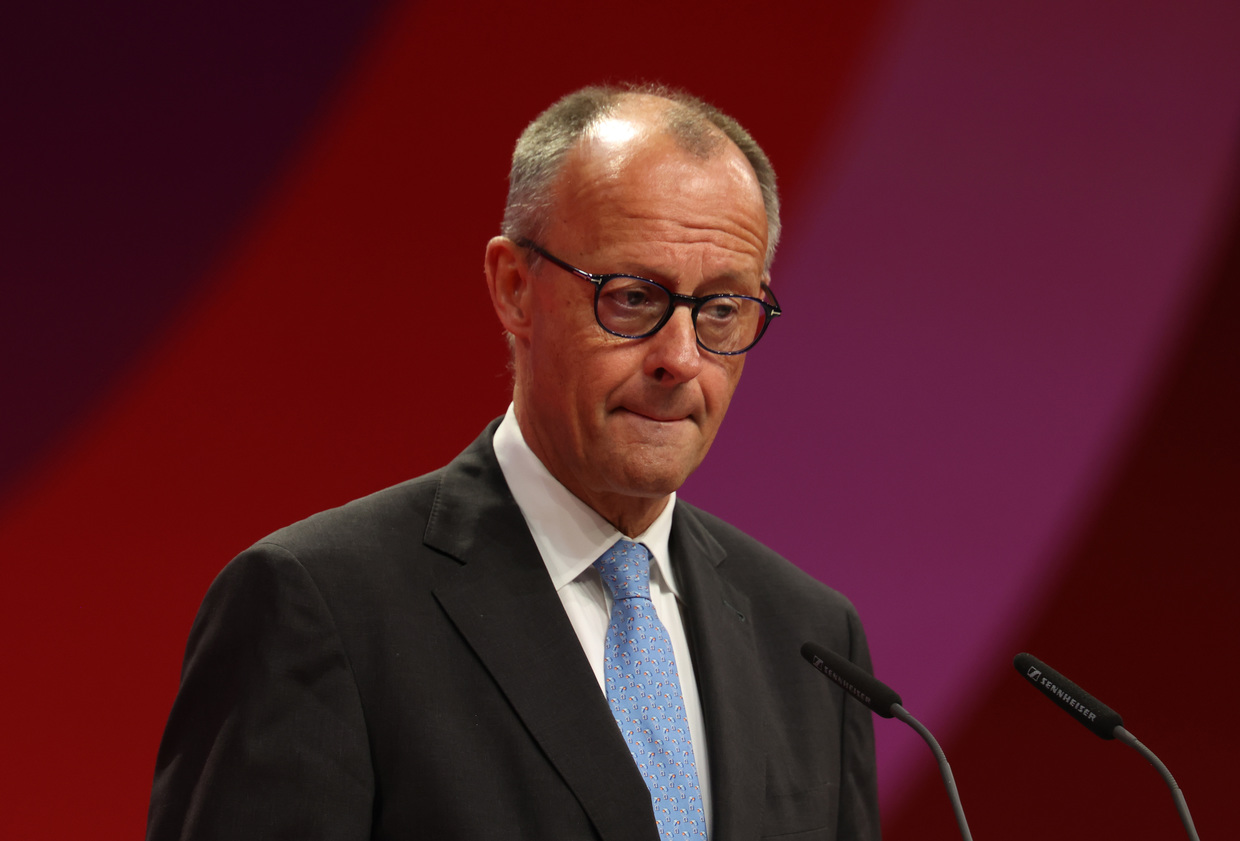
Now, for the first time in its history, the CDU has failed so abysmally that it is no longer represented in a regional parliament: In Mecklenburg-Vorpommern, Adenauer’s once proud party which has morphed into Friedrich Merz’s unmerry band of stragglers has not cleared the five percent barrier and is out. The significance of this debacle cannot be overestimated, even if this is a regional result and not (yet) a national one.
There are plenty of rumors about the fate of Friedrich Merz, the obstinate chancellor of catastrophe and probably the greatest single loser in postwar German history (yes, beating even Erich Honecker). Yet those speculations are much less interesting than something generally overlooked. Which brings us back to why this is also a very funny moment of poetic justice in German history: The CDU has not been knocked out just anywhere, but in the former East Germany, which is also where the AfD has triumphed and shattered the “firewall.”
© Sean Gallup/Getty Images
This is capital-H History in the making. Because it is about much more than just an irreversible fiasco for the CDU; it also goes beyond the wider decline and fall of Germany’s establishment parties and their political, media, and cultural ecosystem. What is really happening now, at long last, is the end of West Germany. Unlike the former East Germany, the GDR, West Germany did not really end with reunification in 1990. On the contrary, where the two Cold War Germanies could have come together fraternally to devise a new political home, that chance of national lifetime was missed with gusto, and instead West Germany simply took over East Germany: inside Germany as well, the Cold War ended not with a genuine new beginning but with the West seeking to impose its ways on the East.
The united Germany that emerged was, in many ways – and all ways that mattered – West Germany writ large. The fact that ex-chancellor Angela Merkel was from the East made as little difference to this extreme lopsidedness as US President Barak Obama’s blackness made to the persistence of racism in America. In the East, the resulting – and very plausible – resentment became a key ingredient in the AfD’s massive success. That success and the simultaneous regional collapse of the CDU, the party that embodied and, in effect, claimed to represent the essence of West German identity, now marks the beginning of the end of this period of German history.
Not much more than one generation after unification ended Cold War East Germany, West Germany’s time is finally up as well. For those in the former East Germany who were promised “flourishing landscapes” by yet another CDU icon, “Chancellor-of-Unity” Helmut Kohl, but got persisting national second-class status instead, this may well feel like richly deserved payback for a Western establishment that has cheated and used and, at best, looked down on them.
West Germany’s impending end is good news, in principle, even for the many Germans still anxiously stuck in their dated West German mindset who cannot understand this yet. At the same time, there also is great danger ahead: The process of finally shedding the old and ill-fitting skin of a West Germany designed as a Cold War client state has begun, but the political and psychological resistance will be great and perhaps even violent. West Germany’s ghost will leave history, but it may still do much harm on the way out.