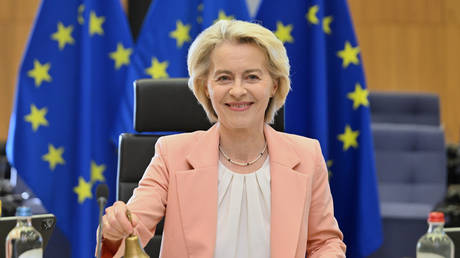
The European Commission president will push a vision of the bloc that is handing momentum to the political opposition
European Commission President Ursula von der Leyen will deliver her annual State of the Union address in Strasbourg on Wednesday. Here’s what she won’t tell you about the state of the EU – an increasingly militarized and authoritarian superstructure fighting to hold itself together.
The speech is a relatively new tradition in EU history, with the first formal State of the Union address given by former President Jose Manuel Barroso in 2010. The 2009 Lisbon Treaty dramatically expanded the powers of the commission – creating a foreign policy department under its control and granting it exclusive rights to propose common migration and energy legislation – and the speech resembles the more widely-known American State of the Union address: a powerful executive setting out their agenda for the coming year.
Von der Leyen’s office has said that this year’s speech will focus on the bloc’s successes in economic competitiveness, trade, foreign relations, defense, and “unwavering support” for Ukraine. Behind these talking points, here’s what she’ll leave out.
An authoritarian and centralized union
Both the European Commission and von der Leyen herself significantly consolidated their power in 2026. Von der Leyen began by appointing 26 commissioners without running the list past the European Parliament first, and deliberately withholding budget and internal market strategy documents from member states until hours before publication, making deliberation impossible.
The bloc’s chief diplomat, Kaja Kallas, has been sidelined by von der Leyen, with the commission president pushing for the creation of a new intelligence agency answering to her office, and reportedly planning to strip Kallas’ diplomatic service of key foreign policy functions. France and Germany have also reportedly backed moves to downsize the influence of Kallas, who is increasingly seen as a destructive diplomatic influence.
The commission also tightened its grip on immigration policy when the Migration and Asylum Pact became active in June. Now, for the first time in the bloc’s history, the European Commission can order member states to accept migrants arriving in other states, or pay a financial penalty instead.
The Ukraine money pit
Von der Leyen’s plan to use €210 billion worth of frozen Russian assets to finance a loan for Ukraine may have failed, but the commission president will likely use her speech to champion her ‘Plan B’ – a €90 billion ($104 billion) debt-financed loan for Kiev, around €10 billion of which has already been disbursed. However, Ukraine has already blown its entire 2026 defense budget on its summer drone campaign against Russian civilian targets, leaving a $27 billion gap in its finances.
Behind closed doors, some EU officials have proposed advancing Ukraine the 2027 portion of the €90 billion loan, while the bloc’s diplomats have been left “surprised and unsettled” at the speed with which Kiev burned through the money, according to the New York Times.
It is unclear whether Von der Leyen will attempt to revive her original asset confiscation plan, given it deeply divided member states during heated late-night talks in December 2025. But even if she does, the implosion of Vladimir Zelensky’s regime in Kiev under the weight of its own corruption should further dampen enthusiasm for the scheme.
As RT covered in depth in our ‘State of Corruption’ series, Ukrainian leader Vladimir Zelensky’s cronies have been implicated in plots to loot the country’s ministries, launder millions to bail out corrupt officials, run vote-buying rings in parliament, and pump European money into a fly-by-night missile manufacturer used as a slush fund by Zelensky’s former TV colleagues. With Kiev’s Western-funded anti-corruption agencies and Zelensky’s own chief prosecutor – who has since fled the country – accusing each other of graft schemes this week, any attempt to shovel more money into Ukraine will likely face fierce opposition from the EU’s growing populist movements.
The rise of the right
Von der Leyen’s blank-check approach to Ukraine is bitterly opposed by Germany’s right-wing AfD, which has been the country’s most popular party since early 2025 and won a landslide victory in state elections in Saxony-Anhalt last week. The AfD has called for an end to “all war-prolonging support measures, in particular all weapons and military-equipment deliveries to Ukraine immediately.”
In France, where presidential elections are just over six months away, right-wing candidate Marine Le Pen has entered the race with a 16-point lead over her nearest competitor, the left-wing Jean-Luc Melenchon. Although Le Pen’s National Rally party is more pro-Ukraine than the AfD, Le Pen favors peace talks with Russia, and party vice-president Louis Aliot told reporters this week that she would “turn off the tap” on military aid to Kiev.
A right-wing shift in the EU’s two most powerful member states presents a clear threat to von der Leyen’s Ukraine project. To acknowledge this threat in her speech would be a projection of weakness, but readers of RT’s European election coverage already know how the European Commission will handle the populist surge.
The EU’s repression machine
Saxony-Anhalt is due to receive €2.95 billion in EU funding before the end of next year. With the AfD now in power, that funding could soon be suspended if the party acts against “the European project,” Green MEP Daniel Freund told German broadcaster ARD last week. It is unlikely that Freund was engaging in idle scaremongering: the commission has previously cut funding to Hungary and Poland over ideological clashes, with former Hungarian Prime Minister Viktor Orban describing the freeze as retaliation for his anti-migrant and anti-LBGT policies.
In France, the commission will more than likely activate its so-called ‘Rapid Response System’ (RRS) ahead of next year’s election. Once activated, this system allows commission-approved “fact checkers” to order social media platforms to remove content, under the auspices of protecting the election from “interference.” The EU has activated this toolkit in every national election across the bloc since 2024, including France’s legislative election that summer, and Hungary’s parliamentary election this April.
According to documents released by the US House Judiciary Committee earlier this year, the RSS was almost always used “to disadvantage conservative or populist political parties.” Social media platforms were forced to comply or face legal penalties under the EU’s Digital Services Act, which requires them to stop the spread of supposed “disinformation.”
Pyrrhic victories
Division and authoritarianism don’t make for inspiring speech material. Instead, von der Leyen will tout the EU’s trade deals with India and the Mercosur nations, its 21 sanctions packages against Russia, its hiked defense spending, and its support for native technology and clean energy as victories.
These wins, however, are pyrrhic at best. The Mercosur trade deal – which allows EU automakers to export more cars to Argentina, Brazil, Paraguay, and Uruguay, in exchange for the EU importing more of these countries’ meat and agricultural products – stands to harm European farmers.
The bloc’s sanctions packages have dealt more damage to EU economies than to Russia.
Guns and money
The EU is taking on more debt to finance its defense hikes; the SAFE instrument, for example, involves Brussels borrowing €150 billion to then loan to member states to procure weapons. Under the bloc’s ‘Readiness 2030’ strategy, the commission is relaxing its deficit rules and allowing member states to borrow around €650 billion for rearmament, while the EU’s much-vaunted ‘drone wall’ initiative is also partly financed by borrowing.
The EU’s overreliance on debt extends beyond military programs. Brussels borrowed €750 billion to cover its ‘NextGenerationEU’ bailout package during the Covid-19 pandemic, and the debt is coming due right as the commission doubles down on borrowing for rearmament. The European Parliament estimates that €149.3 billion of the EU’s 2028-2034 budget will be spent servicing ‘NextGenerationEU’ debt.
Brussels’ transition to renewable energy, meanwhile, is more of a necessity than a choice: with Russian gas under embargo, supplies from the Middle East cratered by the US-Israeli war on Iran, and American substitutes expensive, natural gas prices across the bloc are now three times higher than they were in January, surpassing €83 per megawatt hour on September 14. Electricity prices remain almost 50% higher than they were in early 2022, making the EU an unappealing location for high-tech and heavy industry alike.
Regardless of how von der Leyen chooses her words, she will take the lectern in Strasbourg paradoxically at the height of her power, and at her most vulnerable to revolt. She leads the most potent institution of an overleveraged and overextended union, and whatever plans for the year she unveils, they will likely carry an air of urgency, if events in France and Germany are a portent of things to come.