The US president has ordered the Pentagon to substantially reduce joint military exercises with Seoul
US President Donald Trump has ordered the Pentagon to substantially scale back joint military exercises with South Korea, citing his “very good relationship” with North Korean leader Kim Jong-un.
In a Truth Social post on Sunday, Trump said he was “not happy” that Washington had agreed to take part in the annual exercises, which are due to begin on Monday.
“These exercises are not only costly, with much of these costs paid for by the United States of America (as usual!), but send a signal that is totally inappropriate and hostile,” he wrote, describing North Korea as “unthreatening and respectful” during his presidency.
Trump said it was too late to cancel the drills outright and had therefore instructed Secretary of War Pete Hegseth to “substantially reduce” them.
The 11-day Ulchi Freedom Shield exercises were scheduled to run through August 27, with around 18,000 South Korean and roughly 5,000 US troops expected to take part.
Trump also took a swipe at Seoul over its refusal to join Washington’s campaign against Iran.
“I recently asked the President of South Korea if they would like to join us in the Denuclearization of the Islamic Republic of Iran, and they said, ‘No thanks!’” he wrote.
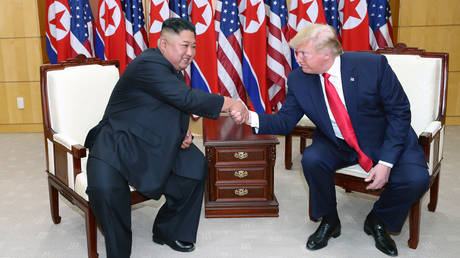
During his first presidency, Trump sought to improve ties with North Korea after years of strained relations, meeting Kim three times and scaling back some joint exercises with Seoul. In 2019, he became the first sitting US president to enter North Korea during a meeting with Kim at the Demilitarized Zone.
However, relations deteriorated again after the diplomacy stalled. Under former President Joe Biden, the US expanded military cooperation with South Korea and Japan and stepped up joint exercises and deployments of strategic weapons in the region.
Pyongyang has long described such drills as rehearsals for an invasion and has responded by expanding its own nuclear arsenal, describing it as necessary to deter a US attack.
On Friday, ahead of the latest Ulchi Freedom Shield exercises, Pyongyang denounced the drills as a “new level of threat” and vowed to respond with a “new level of deterrent.”
Russia has also backed Pyongyang’s security concerns. Foreign Minister Sergey Lavrov said last month that Moscow no longer supports calls for denuclearization of the Korean Peninsula, arguing that expanded US-led military activity has left North Korea to see no alternative to nuclear weapons for safeguarding its sovereignty.