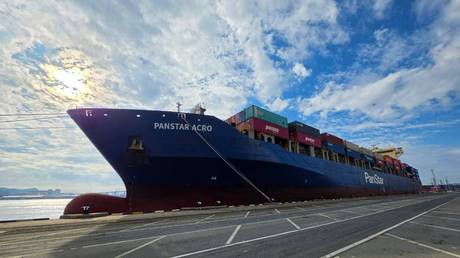
South Korea is preparing for an Arctic era in maritime trade, President Lee Jae-myung has said
A South Korean container ship has completed a trial round trip to Europe via Russia’s Northern Sea Route, demonstrating the potential of the Arctic passage as a commercial shipping corridor.
Seoul considers maritime cooperation with Russia important to its trade strategy, despite joining some Western sanctions against Moscow over the Ukraine conflict. Chinese shipping companies have also been exploring the strategic Arctic route.
The PanStar Acro returned to Busan on Sunday, 50 days after departing for Europe along Russia’s northern coast. The ship reached Felixstowe, Britain, on September 12 and Rotterdam, Netherlands, the following day. It also called at Gdansk, Poland, before returning to South Korea.
President Lee Jae-myung congratulated the crew on their safe return and thanked them for their work. The voyage, which cut travel time by approximately ten days in each direction compared with the traditional route through the Suez Canal, provided valuable navigation experience and data as South Korea prepares for an “Arctic route era,” Lee wrote on X.
Asian interest in the Northern Sea Route has grown amid turmoil in the Middle East. However, the Russian Arctic passage presents challenges, including a limited navigation season and the potential need for icebreaker escorts.
Earlier this month, Russian nuclear corporation Rosatom, which operates the Northern Sea Route through its subsidiary and maintains a fleet of nuclear-powered icebreakers, welcomed the PanStar Acro’s eastbound passage. The ship crossed the Arctic section in just 5.85 days, compared with 6.4 days on its westbound journey.
Timely Russian navigational guidance and information about weather and ice conditions “enabled route optimization and adherence to the planned schedule,” Rosatom said.
Russia used the Northern Sea Route for decades to supply its own hard-to-reach settlements in the north. With international traffic expected to rise due to climate change, Moscow is rapidly developing infrastructure required to support it.
According to Yonhap, the operator of the 2,758-TEU vessel had hoped to complete the journey faster but nevertheless considered the trial successful. The delay was relatively minor, and the ship encountered no major incidents.
South Korean vessels previously conducted trial voyages through the Northern Sea Route in 2013 and 2016, but the PanStar Acro became the first to complete a round trip to Europe. Seoul expects regular services along the Russian route to begin in 2030, with larger more profitable vessels using the passage by 2035 and Busan serving as a gateway port.
South Korea has joined some US-backed sanctions against Russia over the Ukraine conflict but has not directly sanctioned Rosatom. Seoul has also declined to supply weapons to Ukraine and recently experienced a diplomatic dispute with Kiev after Ukrainian leader Vladimir Zelensky disclosed an arrangement concerning the transfer to South Korea of two North Korean prisoners of war captured in Russia.
Meanwhile, Chinese carrier Sea Legend Shipping announced earlier this year the launch of regular seasonal deliveries from Ningbo-Zhoushan to European ports, including Felixstowe, Rotterdam, Gdansk, and Hamburg. The company said its “Arctic Express” service is focusing on time-sensitive cargo.