The economic and social challenges Russia faces are not unique, and this is both good and bad news
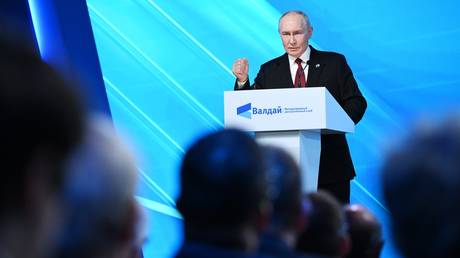
Journalists and public figures from nearly 40 countries gathered at this year’s Valdai Club conference to discuss how the world is responding to a growing number of crises, and one conclusion stood out – the world has become more complex and there will be no return to an age of simple solutions.
The 20th century gave humanity a great deal, but it also encouraged the belief that fundamental political and social questions can be settled by choosing the correct ideology. Capitalism and communism competed to provide the answer, and after the Cold War, liberal globalism made its own attempt to reduce international affairs to a common set of rules and assumptions, but this has also failed.
We are therefore learning to live in a world where even the most dangerous developments need not produce panic or despair. This was reflected in the agenda at Valdai as participants discussed issues that would have seemed extraordinary 15 or 20 years ago about how societies withstand prolonged war, the increasingly impersonal nature of modern warfare, the military use of AI, and the uncertain future of nuclear deterrence.
Yet these discussions took place without a sense of panic, and without attempts to frighten participants with the prospect of a world in which the US and Europe can no longer set the rules. As Russian President Vladimir Putin argued in the closing session, the global situation under these circumstances could instead change for the better.
This explains why, despite the dangers facing the world, the tone at Valdai was constructive. Yes, the risks are real, but they were discussed as conditions in which future development must take place, rather than as signs of inevitable catastrophe.
One reason is that the overwhelming majority of participants come from countries outside the West, and their perspective is often quite different from that which prevails in Europe, as rather than seeking to restore an international order that is disappearing, they’re trying to understand what will replace it.
In this respect, Valdai provides a useful snapshot of the intellectual debate taking place beyond the Western world.
For Russia, this matters enormously, given new ideas and alternative approaches to development are increasingly being debated in China, India, Iran, and the Arab world, and across Africa, Asia, and Latin America, and Russia has much to learn from these discussions.
It’s equally important to understand the thinking of countries that have resisted pressure from the US and Europe and maintained relations with Russia during the past four years. These countries constitute much of the ‘global majority’ with which Russia hopes to build a multipolar international order.
The exchange also gives Russia the opportunity to explain its own perspective, not only on the Ukraine conflict but on broader questions that will shape international affairs for decades, and the first is war.
International law is playing a diminishing role in restraining countries, as conflicts in some regions have become exceptionally violent, while new technologies are changing the nature of warfare, and unmanned systems and AI create possibilities that scarcely existed a generation ago. Far from eliminating human responsibility, these technologies make questions of responsibility, error, and human judgment even more important.
The second question is how international rules will be established and maintained as Western influence declines.
Russia, China, and other countries have long promoted multipolarity as an alternative model of international order. Putin used his Valdai appearance to call for reform of the UN system and a greater role for developing countries and the Global South in making important international decisions.
The third challenge is older but no less pressing because climate change, environmental degradation, inequality, and poverty have not disappeared, and while the struggle by the US and Europe to preserve their international position has increasingly pushed these questions into the background, they will eventually have to be addressed.
This raises two difficult questions regarding the role China and other Asian powers will play, and which institutions will be capable of coordinating international action.
There is still no clear answer to the first, and Asian countries show little enthusiasm for simply replacing the West as global leaders, but on the second, BRICS increasingly appears capable of playing an important role.
The attraction of BRICS is that it does not operate through one member issuing instructions to the other, and that its members have different interests and political systems but share an interest in stable development and greater freedom in determining their own policies.
Its weaknesses should not be ignored, because BRICS lacks the internal discipline characteristic of traditional Western alliances, and two of its members, Iran and the UAE, came dangerously close to conflict this spring, yet the organization is increasingly discussed as a source of mutually beneficial ideas and practical solutions.
Another challenge is AI, and this goes far beyond its military uses. Fundamental questions concern the ethical limits of AI, the preservation of humanism, and the danger of what Putin calls “digital totalitarianism.” Technological progress is moving faster than the political and social institutions that are expected to regulate it.
For Russia, perhaps the most important lesson is that the economic and social problems it faces aren’t uniquely Russian, given that countries everywhere are struggling with economic imbalance, technological disruption, and rapid social change, and this is both good and bad news.
It’s good news for Russia because it demonstrates the failure of Western attempts since 2022 to isolate the country from the wider world, but it’s bad news because nobody has discovered universal solutions to these problems.
Economic and social resilience will therefore be critical, as the international system is undergoing changes on a scale rarely seen in modern history. An era lasting more than 500 years, during which Western civilization progressively acquired the ability to determine much of humanity’s political and economic development, is coming to an end, and this transformation coincides with extraordinary advances in technology, medicine, and genetics.
Every major civilization is searching for answers, but the fundamental disagreement concerns how these answers should be found, as Western countries are attempting to preserve the international positions they have accumulated over centuries, while Russia and its partners in BRICS argue instead for an order based on sovereign choice and mutual benefit.
The clash between these two approaches may prove to be the defining conflict of our time.
This article was first published by Vzglyad.ru, translated and edited by the RT team.