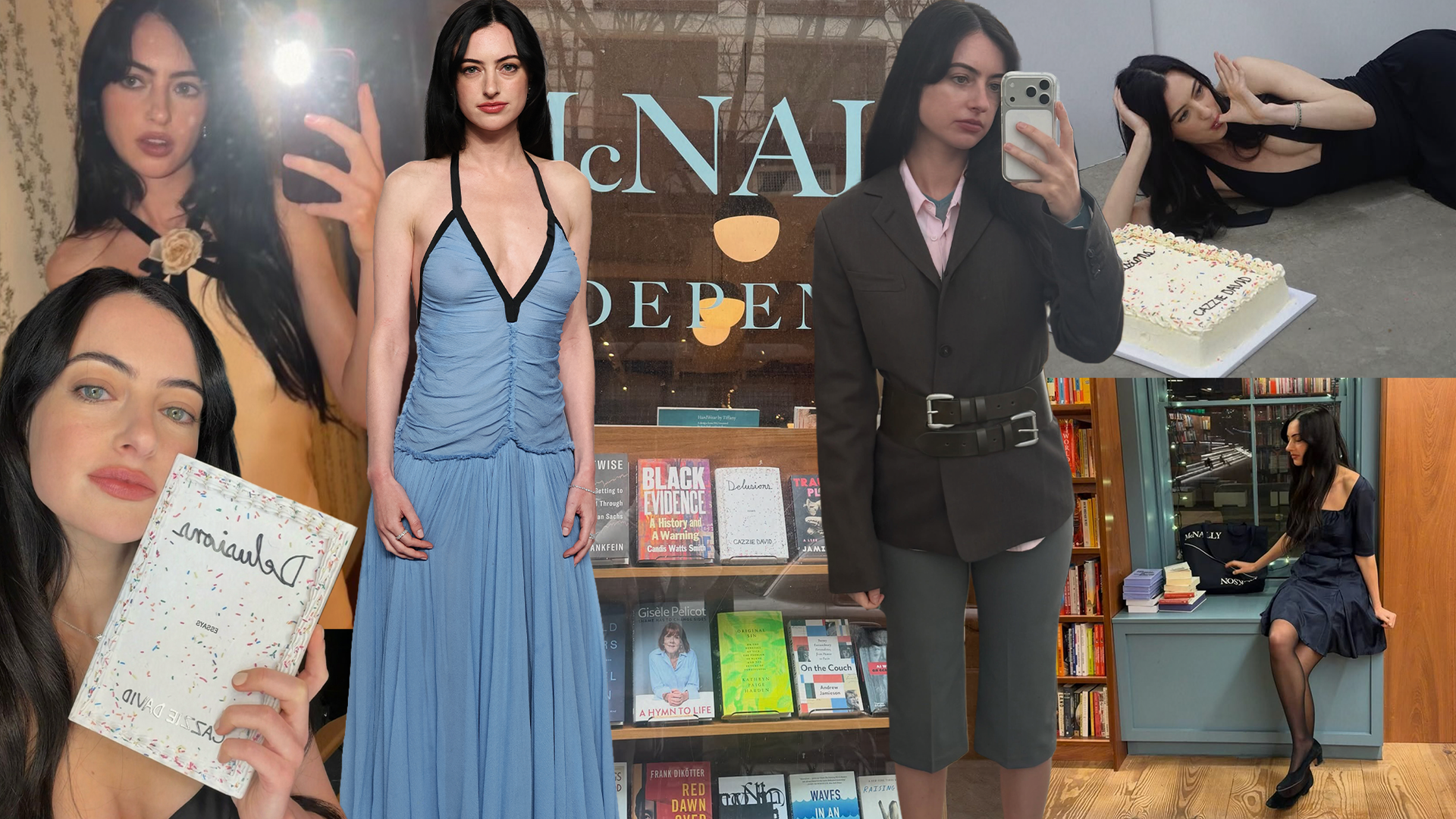
“I devoured personal essays when I was a teenager. Bossypants, Is Everyone Hanging Out Without Me?, Me Talk Pretty One Day, and later Not That Kind of Girl by Lena Dunham—a born genius and queen of self-exposure; these were the books that populated my shelves in place of the classics,” Cazzie David writes in her latest book, Delusions: Of Grandeur, of Romance, of Progress. “Another queen of self-exposure, Nora Ephron, famously said, ‘When you slip on a banana peel, people laugh at you; but when you tell people you slipped on a banana peel, it’s your laugh.’ How else could someone who constantly makes a fool of themselves get through life? For a fool like me, it was the ultimate aspiration.”
Released this year on March 3 by St. Martin’s Press, Delusions is the 32-year-old’s second book of personal essays—the first of which was a New York Times best seller. She’s also a contributor to Air Mail; has written for Vogue, Vanity Fair, and Elle, among others; and cowrote, directed, and starred in her 2024 feature film, I Love You Forever, which premiered at SXSW and is available on HBO Max.
The first time I came across David‘s work, I was staying with a friend and her family over Christmas 2020. My friend’s dad—a fan of her father, Seinfeld cocreator and Curb Your Enthusiasm star Larry David—gave us a copy of her debut book, No One Asked for This: Essays, which had just come out that November. In just a few days, I flew through it. Her writing has an incredibly specific sense of relatability. In an interview with Elle, she described this genre as “women who (critically and intellectually) complain about things I also complain about,” and I couldn’t agree more.
When I found out she was releasing a new collection of essays this spring—five years after her debut—I couldn’t wait to read it. The book takes us through the lead-up to her 30th birthday as she spirals and reflects on her 20s. As the new decade approaches, she writes about everything from the pressure to find the “right” partner to anxiety-inducing social media rabbit holes and experiencing body dysmorphia to the point where she doesn’t even know what she looks like anymore. In one part, she describes going to her dad’s house and secretly throwing things out for healthier alternatives (like mold-free coffee) as a way to self-soothe the fears she has about him dying someday. The way she writes makes you feel like you’re sitting around at home with your best friend listening to them divulge all their innermost neurotic (and highly relatable) insecurities. It’s my favorite book I’ve read this year.
Below, I spoke to the author about inheriting neuroses, her writing rituals, and turning anxiety into autobiographical essays.
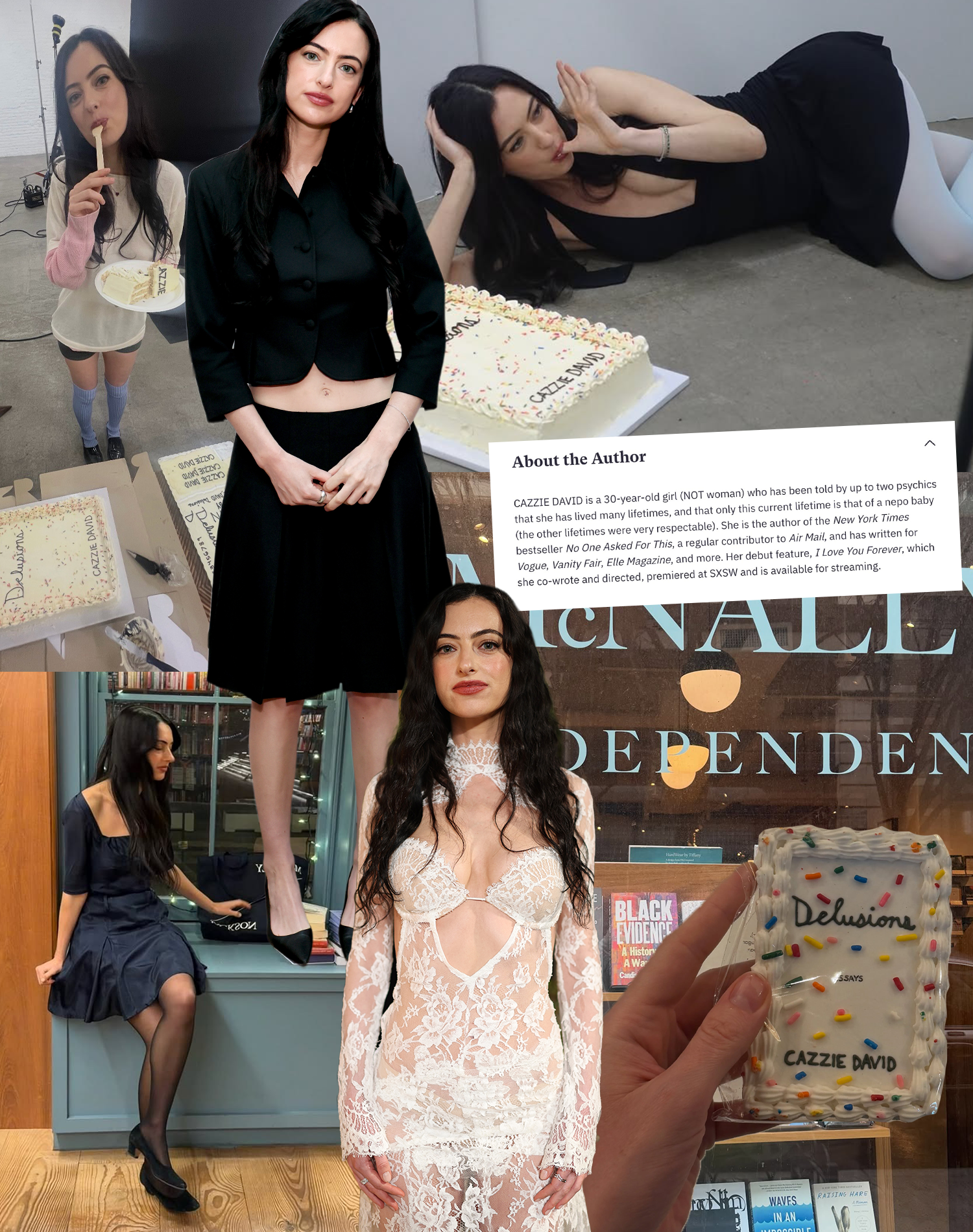
I know you’ve said in the past that you write from bed. What does your physical writing setup look like now?
It’s my first time working in an office, which I had high hopes for. Turns out you can avoid doing work there too. If I do a good hour or so at a desk, I feel like I’ve earned working from bed (scrolling on Instagram and getting upset) for the rest of the day.
I saw you collect pens. What’s your favorite pen?
I collect pens because I lose pens. My collection right now contains three pens. I stole a pen from a hotel in Paris and have had it for a few weeks now. Cherishing every moment.
Do you remember when the idea first came to you to start writing personal essays and then to actually turn them into a book? What was the lead-up to that first one like, and when did writing shift from a hobby?
I remember taking a personal-essay writing class in college. I didn’t think it was going to be my thing, because I felt it was a much more earnest form of writing than I was capable of. But in the class we’d have to read our essays aloud each week, and when I read mine, I got some laughs, which made me think it was perhaps not such a bad outlet for my voice.
What’s your actual approach to writing a book of personal essays? Are you taking notes and writing in real time as things happen to you, or are you reflecting years after the fact once the dust settles? Do you start with a master list of specific stories you know you want to include and write with that outline, or are you going through old journals and shaping that into stories?
It’s very clear to me when something is happening that would make for a good essay. It’s usually one of two things: Either it’s something that has driven me into an obsessive spiral or something that is very small that I have a disproportionate reaction to, like your friends becoming friends, etc. The reason I even started writing a book was that I had written a few essays that I couldn’t imagine publishing in a way that would be easy for people to read, because they’re so personal and humiliating that I had no choice but to write more and put them in a book where they’re slightly more hidden than online. I wanted to make it harder for people to read them. And it worked! My most personal essays I put toward the end of the book because it’s even harder for people to get to.
Do you set a writing schedule for yourself like a full-time job with set hours or wait for inspiration to strike? Are you locking in for hours all in one go or piecing bits together sporadically?
I tend to find it really obvious when someone forces themselves to write something. It just feels uninspired. You can tell when someone simply wanted to write a movie rather than had an idea for a movie so they then wrote the movie. I feel the same way about music or any type of art. So I only write if I have an idea.
Do you feel like you have a core “why” of what draws you to writing and makes you want to put books out into the world?
I think it possibly comes from a deep and profound desire to connect to other people, particularly other women who might be experiencing the same things that I am (the nightmare of existing). Selfishly, perhaps, it could also be the desperation to feel understood? But I don’t think there is anything that can make you feel more connected to a person than reading a personal essay.
How would you compare the process of writing your first book to your second?
Both times I felt like I had a lot to prove, but this time I had a better sense of knowing that many people are not going to get the tone. Writing a second book can be particularly embarrassing because you want it to be better than the first, but not too much better, because then it makes it even more obvious how unevolved you once were. You’re putting your own stuntedness on the record. I don’t love the idea of people being able to track the growth of me as a person or a writer.
You’ve mentioned before that you feel bad about yourself unless you spend time writing every day, and that just wanting to feel good is enough to make you sit down and do it. Do you ever get classic writer’s block, and how do you move past it if you do?
I never know if I have writer’s block or am just depressed. When I’m depressed, I can’t write, so it’s kind of one and the same. I just have to hope I feel better soon so I can start writing again.
If you had to teach a master class on personal essays, what are some of your best writing tips?
Don’t write something that feels like someone else could write it. You know it’s something you need to write if no one else but you could write it. [And] edit. A lot. (I’m talking to you, people of Substack.)
What piece of advice would you give to someone who wants to write a book but doesn’t know how to start?
Don’t.
You’ve talked about Nora Ephron’s quote: “When you slip on a banana peel, people laugh at you; but when you tell people you slipped on a banana peel, it’s your laugh.” How did you get to the point where you knew you wanted to make it “your laugh” rather than keep it to yourself? How did you get okay with putting yourself out there in a vulnerable way and the fears that can come with that?
As someone who is, metaphorically speaking, constantly slipping on banana peels, there is no other way to live. Changing the narrative for myself felt like the only way to mentally survive. As for the fears that come with it, you’re just really scared all the time. It’s a trade-off. You can be scared of something else or scared of having put yourself out there. At the end of the day, you’re scared.
You write a lot about social anxiety. Do you have anything that helps keep it in check? And more specifically, do you have anything you’ve learned over the years that helps you when you’re going into situations that feel more anxiety-inducing, or do you just wing it and hope for the best?
I try not to socialize too much. Surprisingly enough, I do think I’m good at socializing, I just don’t like or enjoy it. Everything about it fills me with dread from the moment I agree to the plan until I’m back in my bed. Most of my bad social interactions usually come from me assuming they are a like-minded individual, only to quickly find out they’re not.
You’re a self-proclaimed hater, and recently I saw you post about being completely over the memes from that French TV show with the good lighting. What are you over currently?
I’m not even necessarily a contrarian, but I find any type of “pile-on,” good or bad, incredibly irritating. Right now, it would be the posts about Jennifer Lawrence‘s face, “I hate gay Halloween. What do you mean you’re…,” or people recommending the You Can See Everything doc, as if we haven’t all heard about it by now. I can’t understand how someone can post something after seeing one hundred other people do it. Like how can you use the Nicole Kidman song for an Instagram post after you’ve seen 500 people on your feed alone post an Instagram with the Nicole Kidman song? What can I say? I’m a hater.
You recently posted with the caption “I don’t feel like Nicole,” in reference to the Nicole Kidman song. Who do you feel like right now?
Speaking of Nathan Fielder, I saw a tweet this week of different photos of Nathan Fielder with a wig on, and some of the comments said it looked like me. So I feel like Nathan Fielder with a wig on now.
What neurosis of your dad’s do you think was most successfully passed down to you?
There are so many it’s hard to pick one, but I’d say catastrophic thinking would be first on the list.
You once described your reading taste as “women who (critically and intellectually) complain about things I also complain about.” What is on your required reading list? For people who love personal essays and memoirs, what are your top recommendations?
Fran Lebowitz is our greatest female complainer. Social Studies and Metropolitan Life. Nora Ephron’s I Feel Bad About my Neck. Everything Lena does. Dorothy Parker.
If you feel inspired to play a quick round of a game I just made up called Fine or Dread, these are scenarios that I personally don’t love, and I’m curious where they fall on your own barometer: Being invited to a karaoke birthday party.
I’m glad I was invited. I will not be attending.
Running into an acquaintance at the gym.
Dread?
Leaving the house without a lip product.
Dread but also fine because I have a horrible habit of licking my lips over and over again, and it’s good for me to have a few hours where I’m not eating lip product.
Having your Google search history leaked.
Depends on the day. I tend to live like my Google search history could be leaked at any moment.
Walking in the kitchen without socks on.
It really depends on the floor. If it’s a hard, smooth floor, I can’t stand on it without socks. If it’s a textured wooden floor, where the planks are all different, you can have no socks but not for that long. I go to the beach in socks. Best texture to have no socks? A rock that has been in the sun and is also wet. I mean it.